Introduction
The robotics manufacturing industry currently faces a pervasive challenge: widespread issues with insufficient gear transmission precision, low efficiency, and high costs. These shortcomings lead to increased equipment failure rates and a significant competitive disadvantage. The root cause lies in traditional gear processing methods, which lack the flexibility and precision required for modern robotics’ high-load, high-speed demands. Inadequate process optimization further exacerbates resource waste.
To address these pain points, the introduction of advanced precision gear machining technology, combined with CNC manufacturing and customized processes, presents a viable solution to significantly enhance gear performance and durability. This article will provide a detailed analysis of the critical aspects of precision gear machining, offering readers a comprehensive understanding of the optimization strategies available.
Why is Precision Gear Machining Crucial for Robotics Manufacturing?
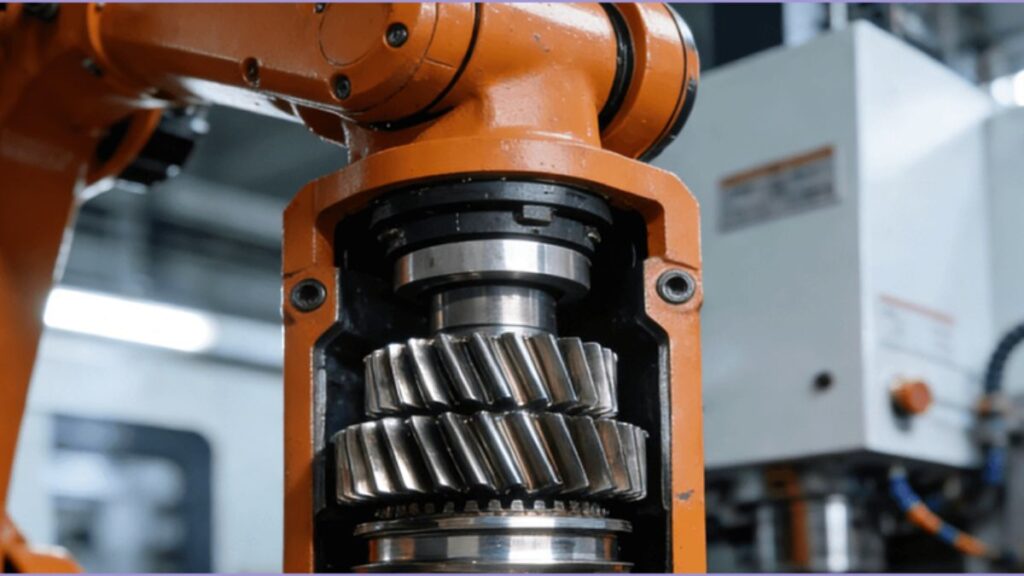
In robotics manufacturing, gears serve as the core hubs for power transmission and motion control. Their precision directly determines the performance ceiling of the entire machine. Gears with inadequate precision cause unsteady transmission, vibration, noise, and significant efficiency losses. Authoritative data indicates that additional friction from poor gear meshing can increase system energy consumption by up to 20% and accelerate component wear.
The Direct Link Between Precision and Efficiency
l The Value of Micron-Level Control
This is where Custom Gear Machining demonstrates its value. Through micron-level control of tooth profile and pitch, custom gears achieve near-perfect meshing, drastically reducing energy loss and heat generation, and increasing transmission efficiency to over 98%. For instance, in robotic joint applications, services specializing in Precision Manufacturing Services provide custom harmonic reducer gears that ensure absolute motion accuracy and efficiency.
l Ensuring Reliability and Longevity
High precision translates directly to reliability. Optimized gear machining processes ensure more uniform contact stress distribution, fundamentally reducing the risk of pitting and tooth breakage. As detailed in the resource Precision Custom Gear Machining for Robotics and Aerospace, this approach can reduce the failure rate of critical moving parts by more than 50%.
The Synergy of Material Science and Finishing
Gear durability depends on more than just geometric precision. Reports from ASM International on material performance confirm that selecting appropriate alloy steels or special coatings, combined with post-machining heat treatments like carburizing and quenching, significantly enhances surface hardness and core toughness. Precision Manufacturing Services integrate materials science with advanced gear machining to ensure long-term stable operation under high-speed and high-load conditions.
Flexibility for Complex Application Scenarios
Modern robotics applications are diverse, ranging from the delicate movements of collaborative robots to the powerful gripping of heavy-duty industrial robots, each with unique requirements for gear specifications, modules, and design. Standard gears are often inadequate. Custom Gear Machining offers unparalleled flexibility to design and produce gears based on specific load curves, spatial constraints, and kinematic requirements, an advantage unattainable with traditional methods.
How to Optimize Gear Manufacturing Processes with CNC Technology?
CNC gear manufacturing is a core technology for enhancing gear quality and consistency. The process begins with digital 3D design and proceeds through CAM programming to directly drive machine tools, enabling a highly automated production flow from “data to tooth form.”
The primary role of CNC Machining Expertise within the entire gear manufacturing process is the elimination of human operational error. Whether for complex involute tooth profiles, modifications, or demanding surface finishes, CNC systems ensure that every tooth’s geometric features strictly adhere to design parameters. This consistency is critical for the batch production of robotic gears, guaranteeing identical motion performance in every unit.
Process parameter optimization is another manifestation of CNC Machining Expertise. Precisely controlling cutting speed, feed rate, and depth of cut not only achieves superior surface quality but also extends tool life and reduces machining time. Case studies show that deep optimization of cutting parameters within the gear manufacturing process can lower overall production costs by approximately 30%. Furthermore, manufacturers adhering to quality management system certifications like ISO 9001 ensure every step, from programming to final inspection, is controlled, thereby enhancing product reliability. Applications of CNC in NASA’s technical reports for aerospace precision components corroborate the authority of this technology in fields demanding extreme accuracy and reliability.
How to Integrate Rapid Prototyping Technology to Accelerate Gear Development?
In the competitive robotics market, shortening product development cycles is essential. The introduction of Rapid Prototyping Technology has brought revolutionary speed advantages to industrial gear manufacturing.
Agile Iteration from Design to Physical Part
Traditional gear mold manufacturing is time-consuming and costly. Utilizing technologies like 3D printing for Rapid Prototyping Technology allows engineers to obtain physical gear prototypes within hours. This can shorten the cycle for design verification, assembly testing, and functional evaluation by up to 50%. Teams can quickly identify and correct issues such as interference and stress concentration, avoiding the discovery of defects during costly mass production.
Testing, Optimization, and Cost Control
l Functional and Performance Testing
Functional prototypes enable the testing of gears under actual or simulated load conditions. Engineers can collect real-world data on noise, vibration, and durability, providing critical input for final material selection and heat treatment processes.
l Supply Chain and Cost Optimization
Finalizing all design details with a prototype before committing to mass production minimizes the risk of mold scrapping and production delays caused by design changes. This is strategically important for controlling overall project cost and risk in industrial gear manufacturing. Through professional Gear machining services, developers can even obtain instant quotes for prototypes and small-batch production, significantly improving decision-making efficiency.
H3: Ensuring a Seamless Transition from Prototype to Production
Reliable manufacturers can seamlessly transition successfully validated designs from the prototyping phase to CNC small-batch trial production and even large-scale mass production. Processes adhering to stringent certifications like AS9100D (aerospace quality system) ensure data consistency, process control, and quality traceability from prototype to final product. Standards from the ISO website on Geometrical Product Specifications (GPS) provide an internationally recognized benchmark for quality control during this transition.
Which Quality Control Measures Ensure Zero Defects in Gear Manufacturing?
In a superior gear manufacturing process, systematic quality control is the only way to achieve “zero defects.” The core value of Precision Manufacturing Services is reflected in integrating quality management into every step from start to finish.The process begins with strict raw material inspection, including chemical composition analysis and mechanical property testing, to ensure base material compliance. In-process real-time monitoring is crucial. Modern CNC machines integrate on-machine probing to automatically measure key dimensions during the machining cycle, enabling “machining-measurement-compensation” closed-loop control to prevent deviation accumulation.
Secondly, offline inspection stations are established at key points in the gear manufacturing process. High-precision Coordinate Measuring Machines (CMM), gear measurement centers, and surface roughness testers are used for comprehensive quantitative analysis of tooth profile, tooth direction, pitch accumulation error, and surface integrity. Statistical Process Control (SPC) methods analyze this data to monitor process stability in real-time, nipping potential defects in the bud. Data indicates that such systems can control the defect rate in mass production to below 0.1%.
The final inspection phase involves rating gear accuracy and conducting comprehensive functional acceptance tests according to international standards like those from AGMA (American Gear Manufacturers Association). The entire quality system complies with industry-specific certification standards such as IATF 16949 (automotive industry), which represents not just a certificate but a mandatory culture of defect prevention and continuous improvement. Through these interlocking measures, Precision Manufacturing Services ensures that every delivered gear carries absolute reliability.
What are the Future Trends in Industrial Gear Manufacturing?
Looking ahead, industrial gear manufacturing is undergoing a profound transformation towards intelligence and sustainability. Smart factories integrated with AI and the Internet of Things (IoT) will become mainstream, utilizing real-time data collection and analysis to achieve self-optimization of machining parameters, predictive tool maintenance, and intelligent product quality diagnosis.
In this evolution, CNC Machining Expertise will take on new meaning. Adaptive machining technologies will enable CNC systems to adjust paths and parameters in real-time based on sensor feedback like cutting force and vibration, addressing challenges from material micro-inhomogeneity, thereby enhancing machining stability and surface quality. Predictions from IEEE on smart manufacturing suggest that the widespread application of such technologies could increase comprehensive production efficiency by 40% within the next five years.
Sustainable manufacturing is another major trend. This includes adopting lightweight designs to reduce material consumption, using recyclable or bio-based eco-friendly alloys, and optimizing the gear manufacturing process to lower energy and coolant consumption. CNC Machining Expertise, through simulation software that optimizes cutting strategies in advance, minimizes waste generation, practicing the concept of green manufacturing. By embracing these trends, the industry can effectively avoid the resource waste and performance bottlenecks of traditional manufacturing models, providing a more powerful, greener, and more reliable “power heart” for high-end equipment like robotics.
Conclusion
In summary, to meet the stringent demands of robotics manufacturing on transmission systems, a deep integration of advanced CNC gear machining technology, rigorous customized processes, and end-to-end precision quality control systems can systematically address the core pain points of precision, efficiency, and cost. This provides a reliable technical path for robot manufacturers to enhance product competitiveness and lays a solid foundation for the sustainable development of the entire industry.
Explore professional gear machining solutions now to obtain a customized plan tailored to your specific needs and inject precision and efficiency into your robotics manufacturing process!
Author Biography
This article is written based on years of insight and practical experience in the robotics and precision transmission fields. The team at JS Precision possesses profound technical accumulation in precision gear machining, and its services strictly adhere to international quality and environmental management systems, including ISO 9001 and ISO 14001, committed to providing high-value solutions from design support to mass manufacturing for clients.
FAQ Section
Q1: What is precision gear machining?
A: Precision gear machining involves using advanced processes like high-precision CNC machine tools to produce gears with extremely tight tolerances and excellent surface quality. It ensures smooth, efficient, and long-lasting transmission, serving as a key supporting technology for high-end equipment like robotics and aerospace.
Q2: What are the main advantages of CNC gear machining?
A: CNC machining offers high repeatability and flexibility, enabling the fast and accurate manufacturing of complex tooth forms while minimizing human error. By optimizing tool paths and parameters, it improves material utilization, potentially reducing overall production costs by up to 30%.
Q3: How to select the appropriate gear manufacturing process?
A: Selection requires a comprehensive consideration of the application’s load, speed, precision requirements, and production volume. CNC machining is suitable for high-precision, low-volume, and complex tooth forms, while high-volume production might consider precision forging or powder metallurgy. Consulting experts with CNC Machining Expertise is the best way to optimize the choice.
Q4: What are common quality challenges in gear manufacturing?
A: Primary challenges include tooth surface wear, pitting, dimensional deviations, and heat treatment deformation. Implementing SPC, automated in-process inspection, and adhering to strict standards like ISO or AGMA can effectively prevent these defects, enabling near-zero-defect delivery.
Q5: How is industrial gear manufacturing adapting to sustainability?
A: Trends include adopting lightweight designs, eco-friendly coolants, recycled alloy materials, and using AI to optimize the gear manufacturing process to reduce energy consumption and waste. This not only lowers the carbon footprint but also enhances efficiency, complying with increasingly stringent global environmental regulations.