Sustainable land management practices are increasingly recognized as critical tools for dealing with the challenges of climate change, soil degradation, and the rising demand for food resources. By adopting progressive approaches and integrating innovative techniques, landowners and producers can significantly improve land resilience while maintaining productivity and profitability. Reliable partners, such as Iowa Land Company, play an essential role in connecting landowners with resources and opportunities to advance sustainable land use.
Sound management offers immediate benefits like improved soil and water retention and long-term gains such as ecosystem conservation and food security. Strategic land practices ensure efficient production and protect landscapes for future generations. Sustainable land management requires a mix of traditional and technological solutions, with private landowners, officials, and tech leaders playing key roles. Here are the main strategies ensuring resources stay productive, protected, and resilient.
Regenerative Agriculture
Regenerative agriculture is a comprehensive approach that aims to restore and enhance soil health, foster biodiversity, and capture atmospheric carbon. Core practices include no-till or reduced-till farming, cover cropping, and rotational grazing. These methods not only increase organic matter and water-holding capacity in soils but also boost crop yields and farm resilience. Companies such as Nestlé have invested in regenerative agriculture initiatives worldwide, aiming to reduce their environmental impact and promote sustainable ingredient sourcing. For instance, Nestlé has partnered with Cargill to support regenerative agriculture practices across more than 200,000 acres of corn and soybean farmland in the Midwest, aiming to reduce Purina’s grain supply’s carbon footprint by up to 40% over the next three years.
Farmer-Managed Natural Regeneration
Farmer-Managed Natural Regeneration (FMNR) is a community-driven technique that restores degraded land and combats desertification efficiently and affordably. Originating in West Africa during the 1980s, FMNR involves the selective protection and pruning of naturally occurring tree stumps, roots, and seeds, allowing indigenous vegetation to regrow. The process improves soil quality, increases crop yields, and provides additional resources such as fuelwood and animal fodder. The success of FMNR in regions such as the Sahel has inspired broader adoption across Africa and Asia, illustrating the value of knowledge-sharing among land stewards.
Geospatial Soil Quality Analysis
The emergence of Geographic Information Systems (GIS), remote sensing satellites, and machine learning has revolutionized soil health analysis. These technologies provide large-scale, high-resolution assessments of soil conditions, enabling more agile and precise management decisions. Integrating data from diverse sources — such as aerial imagery, soil sampling, and weather stations — managers can build comprehensive maps that reveal current conditions and forecast future changes. The Scientific Reports journal has highlighted the value of remote sensing in providing actionable insights for ecosystem management and sustainable development policies.
Private Landowner Assistance Programs
Numerous support programs exist to encourage and reward private landowners for engaging in sustainable practices. One prominent model is the United States Department of Agriculture’s Conservation Reserve Program (CRP), which provides technical assistance and financial incentives to landowners who dedicate sensitive land to conservation. These partnerships increase wildlife habitats, curtail soil erosion, improve water quality, and strengthen rural economies. Additional federal and state initiatives further expand the options available to private stakeholders seeking to advance environmental stewardship.
Farmland Preservation Initiatives
Protecting farmland from urbanization and fragmentation is essential for safeguarding food systems and rural livelihoods. Programs like Connecticut’s Farmland Preservation Program have protected tens of thousands of acres, ensuring agricultural lands remain available for future generations. Preservation efforts help maintain open spaces, support biodiversity, and anchor local economies. By collaborating with government agencies, non-profits, and private landowners, these initiatives prevent development encroachment and promote the long-term sustainability of agricultural landscapes.
Sustainable Water and Innovative Irrigation Management
Water stewardship is a cornerstone of sustainable land management. Innovative systems and digital planning platforms enable farmers to increase crop yields while minimizing water use. These technologies employ real-time monitoring, data analysis, and precise irrigation scheduling, conserving valuable water resources even during prolonged drought spells. Enhanced irrigation management, when paired with drought-resistant crops and soil moisture sensors, ensures resilience against shifting weather patterns and climate variability. The United Nations underscores that water scarcity affects over 40% of the global population, highlighting the urgent need for innovative water management solutions.
Role of Technology in Sustainable Land Management
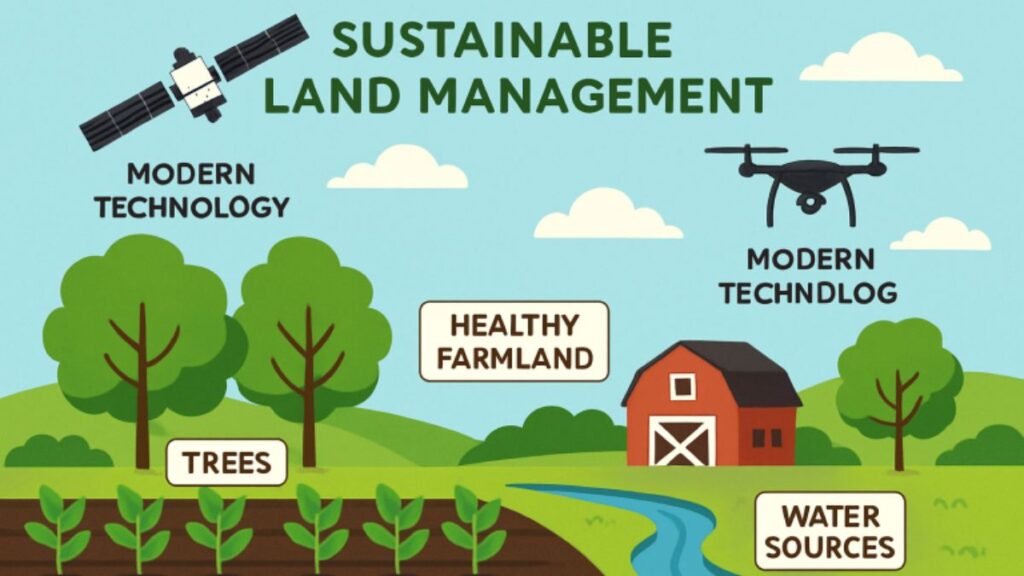
Modern technology is central to the rapid evolution of land management practices. Tools such as satellite imagery, drones, soil sensors, and artificial intelligence are making it easier to track land-use changes, forecast weather events, and detect degradation. These technologies deliver actionable insights that help landowners prepare for and address environmental challenges, such as pest outbreaks, droughts, or encroaching development. Predictive analytics and real-time monitoring can empower decision-makers at every level, resulting in better conservation outcomes and more efficient land stewardship.
Conclusion
Sustainable land management is a multifaceted, rapidly growing field that blends traditional wisdom with innovative science and advanced technology. By embracing these practices, supporting policies, and collaborative programs, society can secure its soils, water, and biodiversity for generations to come. The path forward will require cooperation, adaptability, and ongoing investment in both people and tools that protect our landscapes and livelihoods.