
When an accident happens, the question of who is at fault is rarely simple. In many Pennsylvania personal injury cases, responsibility is shared between two or more parties, making the outcome far more complex than a straightforward claim against a single wrongdoer. This is where the doctrine of comparative negligence becomes critical. Understanding how fault is assigned and how that assignment directly affects financial recovery can make a substantial difference in the compensation an injured person ultimately receives.
Under Pennsylvania law, compensation is not awarded simply because someone was “mostly” right or wrong. Instead, courts carefully examine the actions of everyone involved and divide fault according to each party’s contribution to the accident. Your ability to recover damages, and the amount you may receive, depends directly on this calculation. Even a small percentage of assigned fault can significantly reduce a settlement or verdict. Because insurance companies and defense attorneys often work aggressively to shift blame and minimize payouts, having a clear understanding of comparative negligence is essential. Whether you were injured in a car crash, a slip-and-fall incident, or another type of accident, knowing how Pennsylvania’s fault rules operate can help you protect your rights and pursue the compensation you deserve.
Understanding Comparative Negligence
Comparative negligence is a fundamental principle in Pennsylvania personal injury law. This doctrine is used by courts to determine fault when multiple parties are involved in an accident and to allocate fault based on each party’s conduct. As a result, the parties’ financial responsibility for damages is directly linked to their degree of fault. If you are considering how Pennsylvania law may affect your personal injury case or want to protect your rights, connecting with experienced attorneys like those at Quinnlawyers.com can help you understand your legal options.
The idea behind comparative negligence is fairness: each party pays for the portion of harm they caused. For injury victims, this often becomes the single most important factor in whether and how much they can recover following an accident. Unlike states with strict contributory negligence rules, Pennsylvania’s system seeks to reach an equitable result based on the facts of each case.
Pennsylvania’s Modified Comparative Negligence Rule
Pennsylvania applies the “51% rule,” a modified comparative negligence system. Under this rule, an injury victim can collect damages as long as they are deemed 50% or less at fault for the accident. However, if you are found to bear more than half the blame (51% or more), you will not be eligible to recover any compensation from the other parties involved.
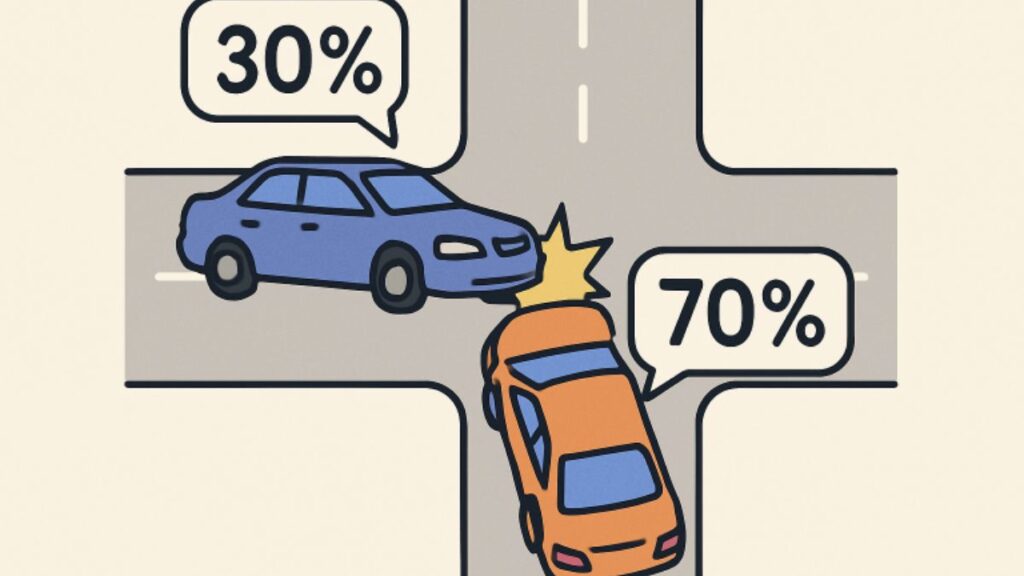
For instance, if you were injured in a car accident and a jury determines you are 30% responsible due to minor speeding, any compensation you receive will be reduced by 30%. If your total damages are $100,000, then you are entitled to $70,000. This direct relationship between fault and recovery can significantly impact both settlement negotiations and trial outcomes.
Impact on Personal Injury Claims
The modified comparative negligence standard shapes virtually every aspect of a Pennsylvania personal injury claim. Legal and insurance disputes routinely focus on gathering evidence to determine who did what, when, and to what degree. Surveillance video, eyewitness testimony, accident reconstruction, and expert analysis are all used to assign fault percentages. Since a victim’s compensation can decrease according to their share of fault, it is crucial to proactively work to minimize your assigned fault through thorough documentation and skilled advocacy.
If the circumstances of an accident are unclear or heavily disputed, each side will present arguments and evidence to sway the fault calculation in their favor. Even a small difference in assigned fault can mean thousands or tens of thousands of dollars in a settlement or verdict. Because these cases can be highly technical and complex, the involvement of seasoned attorneys is vital to adequately protecting your interests.
Real-World Scenarios
Comparative fault issues are common in many different types of accidents. For example, consider a two-car collision at an intersection. One driver ran a red light, while the other was speeding. Both may be found partially liable: perhaps 70% for running the red light and 30% for speeding. Each driver’s compensation for injuries and property damage will be reduced according to these percentages.
Comparative negligence also applies in other cases, such as slip-and-fall incidents and construction site accidents. For example, a pedestrian who slips on an icy sidewalk might receive less compensation if they were distracted by their phone or ignored warning signs. The modified comparative negligence standard ensures that the outcome reflects the realities of the situation, rather than simply awarding damages to whichever party files first.
Statistical Insights
Pennsylvania’s approach to negligence has tangible implications. According to the Pennsylvania Department of Transportation, there were more than 115,000 reportable traffic crashes in 2022, resulting in significant injuries and property losses across the state. Over 4,000 of these involved speeding drivers, and nearly 6,000 incidents involved distracted driving. These numbers highlight how frequently multiple contributing factors exist, necessitating a careful analysis of fault in many cases.
Legal Representation Matters
The stakes in comparative negligence cases can be high, especially because small differences in fault allocation can dramatically alter the ultimate financial outcome. In this environment, the guidance and advocacy of an experienced personal injury attorney are critical. A strong attorney will assemble robust evidence, challenge attempts to unfairly inflate your share of the blame, and present a compelling case to maximize your potential recovery.
Legal teams with proven knowledge of negligence law can spot strategic opportunities to minimize your percentage of fault. They are adept at reconstructing accidents, leveraging expert witnesses, and negotiating with insurers who may attempt to shift blame to reduce payouts. For general perspectives on how to evaluate personal injury lawyers and why effective counsel is so valuable, Nolo provides comprehensive guidance.
In comparative negligence cases, the financial consequences are often determined by just a few percentage points. For this reason, legal precision and a robust presentation of your side of the story are essential.
Conclusion
Comparative negligence has a defining influence on Pennsylvania personal injury claims. The process of determining who is at fault, and by how much, affects every aspect of these cases, from the evidence gathered to the size of potential settlements and jury awards. If you are involved in a car accident, slip-and-fall, or another type of injury, understanding comparative negligence is key to pursuing fair compensation. Knowledge, careful preparation, and professional legal help can make a significant difference in achieving the best possible outcome for your claim.