
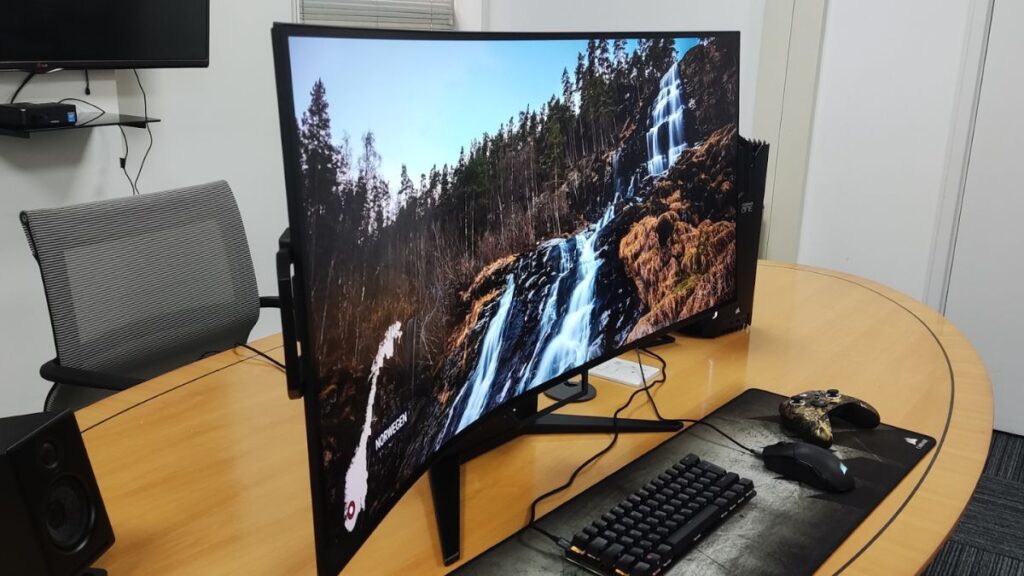
The gaming industry is advancing at an unprecedented rate. Thanks to next-gen console technology, games have never looked better and never run smoother. These improvements place higher demands on display technology and prompt the evolution of new forms of monitors.
Flexible OLED displays and portable monitor solutions have recently been gaining popularity. This article will discuss how these forms of monitors fit into console gaming setups, and how they compare to traditional gaming monitors.
Flexible Monitors for Gaming Consoles
Flexible monitors and displays are no longer only science fiction. Products that allow the monitor to be slightly curved, bent, folded, or flexed in some way are now very real and useful tools for gamers and creators alike.
The typical flexible monitor is a high-end visual display that adds flexibility and functionality in return for a slight cost increase. This article will examine how these can fit into gaming console setups in a modern way.
Flexible Monitor Fundamentals
A flexible monitor uses a specially designed flexible panel that can be made from OLED, or other similar technology. A traditional LCD monitor uses glass panels and backlighting, but a flexible OLED monitor uses a self-emissive OLED panel on a flexible substrate. This lets the screen be curved, folded, or adjusted safely.
For gaming, the result is a monitor that can be adjusted according to the needs of the situation. A monitor could be set to a slight curve for gaming, be completely flattened for competitive gaming, or be folded to adjust the visual angle in other ways. The advantage to a flexible monitor over traditional displays is the adjustability without sacrificing any resolution or visual quality.
Need for Better Gaming Displays with Next-Gen Consoles
The new generation of video game consoles offers immense power and premium-level visual capabilities. Gamers can now expect high frame rates, advanced HDR support, ultra-high resolutions, and lower latency outputs from their consoles. For the monitors to keep up with the demands of these consoles, they must be able to support higher refresh rates, better contrast, and more accurate colors.
Flexible OLED display technology is very well suited to these uses. With near-instantaneous pixel response times, excellent contrast ratios, and vibrant HDR support, OLED screens work great with next-gen consoles. When combined with powerful next-gen consoles, flexible monitors allow for smooth motion, little to no input lag, and more cinematic and realistic visuals than ever before.
Flexible Monitors: Advantages in a Console Gaming Setup
The most unique and beneficial features of flexible monitors are in how they allow for customization, adaptation, and mobility in gaming setups. This section will detail the biggest advantages of flexible monitors for gaming.
Improved Viewing Immersion
Flexible monitors provide better immersion by default. A monitor can be curved slightly to match the natural shape of human vision. This helps with peripheral vision and creates less strain on the eyes, which is an especially useful feature for racing games, open-world games, and first-person shooters.
The difference with flexible monitors over fixed curve monitors is that the gamer can decide how much curvature is best suited for the game they are playing. Some players want a completely flat screen for more competitive games while others want the best immersion possible for a more cinematic experience.
Better Space-Efficiency and Ergonomics
Flexible monitors work great in tight or compact spaces. This is because a flexible monitor can adapt more easily to limited desks, multi-monitor set-ups, or alternative mounting solutions. Flexible monitors are often slimmer and lighter than other gaming displays, making them easier to mount in space-limited situations.
In terms of ergonomics, a flexible monitor can also reduce strain on the player. Because the display can be adjusted to the player, the neck and back don’t have to strain to look at an awkward screen. This can greatly improve the experience and duration of gaming sessions.
Portability and Multipurpose Functionality
Gamers these days are increasingly looking for set-ups that can be portable, multi-purpose, and mobile. Portable monitors are a great option for this, but flexible monitors go one step further by also being bendable. This makes them lighter and more easy to store, making them even more mobile and accessible.
Gamers that go to tournaments, LAN parties, and move around more often will particularly appreciate having a monitor that does not need to be packed into bulky protective cases. A flexible display is also more suited to use in a secondary capacity like streaming, monitoring chat, or productivity if gaming is not the main use.
Flexible Monitor vs Portable Monitor vs Gaming Monitor Comparison
The table below shows a comparison between flexible monitors, portable monitors, and traditional gaming monitors.
| Feature | Flexible OLED Monitor | Portable Monitor | Traditional Gaming Monitor |
| Form Factor | Bendable and adjustable | Thin and flat | Rigid and fixed |
| Portability | High due to lightweight build | High | Low |
| Immersion | Adjustable curvature enhances immersion | Limited by flat design | Fixed curvature or flat |
| Desk Space Efficiency | Excellent | Good | Moderate to low |
| Image Quality | High contrast and deep blacks | Good to very good | Very good to excellent |
| Response Time | Very fast | Fast | Fast |
| Setup Flexibility | Very high | Medium | Low |
| Best Use Case | Immersive and adaptive gaming setups | Gaming on the go | Dedicated home gaming stations |
As seen in the table, flexible monitors provide the benefits of a portable monitor without sacrificing any visual performance. Gamers who are interested in using a mobile display can use any of the above options for their needs.
Integration with Next-Gen Consoles
Flexible monitors can be a great addition to next-gen console gaming. This is because they are easily able to handle the modern video signal standards. High refresh rates, low response times, and wide color gamuts support extremely fast-moving and colorful games.
Another factor that makes flexible monitors ideal for console gaming is the low-latency performance. Flexible displays, especially those based on OLED technology, offer minimal delay in pixel transition, which is critical for competitive gamers.
Gamers who use next-gen consoles have a wide variety of set-up styles. Console gamers are more likely to use relaxed seating positions and living-room set-ups, or mixed desk-and-couch gaming. Flexible displays allow the screen to be adjusted to these needs.
Drawbacks and Things to Consider
It should be noted that there are some drawbacks to flexible monitors, as with every other display technology. Flexible OLED screens are more expensive to manufacture than traditional screens, which results in higher prices on average. Another limitation is that not all flexible monitors are able to support the highest resolutions or refresh rates on offer in premium gaming monitors.
Durability can also be a concern. Although flexible displays are built to withstand bending and other physical manipulation, the lifetime of the product may suffer if pushed too far. Gamers are advised to follow manufacturer recommendations on minimum and maximum bending angles.
As technology improves and more flexible monitors are made, these problems are likely to subside.
Portable Monitors for Gaming Consoles
Portable monitors are also a great choice for gamers who wish to play on consoles with a display. This is because it allows a player to hook up their console to a display and be ready to play instantly.
Flexible monitors can be thought of as an evolution of the portable monitor, where players still enjoy the mobility of a portable screen but with the addition of flexibility. Gamers that currently use a portable monitor will likely see a great difference in visual quality when upgrading to a flexible OLED monitor.
Frequently Asked Questions
Are flexible displays any good for gaming?
Yes, flexible displays are well-suited to gaming because they offer the full advantages of an OLED or similar screen plus the added features of flexibility. Flexible monitors can have a highly competitive response time when made of OLED and may have a reduced glare and potential for an immersive viewing experience.
Can I use a flexible OLED as my main monitor for console gaming?
Yes, for many console gamers, a flexible OLED display can make an excellent replacement for a traditional monitor, especially if space-efficiency and customization are priorities. However, some high-end players may still opt for rigid monitors with the highest refresh rates.
Do flexible monitors support HDR?
Yes, most flexible monitors these days can support HDR modes and 10-bit color depth. Flexible OLED monitors often have some of the best HDR performance around.
Are flexible monitors any better than a portable monitor?
Flexible monitors offer more customization, adaptation, and mobility than portable monitors. While both types of displays are portable and light, flexible monitors have additional features such as adjustable curvature and better ergonomics.
Will flexible monitors work with next-gen consoles?
Flexible monitors are well suited to the higher video standards of next-gen consoles. Next-gen consoles have high refresh rates, low response times, and wide color gamuts, all of which are supported by flexible OLED monitors.
Conclusion
Flexible OLED monitors are a powerful and interesting new form of gaming display. Their advantages in terms of immersion, space-efficiency, and customization make them a unique and useful choice for many gamers. Flexible monitors are one of several options to consider when building or upgrading a gaming console set-up.
Flexible monitors are just one of several modern forms of displays that can be integrated into a next-gen console setup. Portable monitors and flexible monitors have unique advantages and trade-offs that gamers should consider. For those that are on the fence between purchasing a portable or flexible monitor, it is recommended to go with the more flexible version.